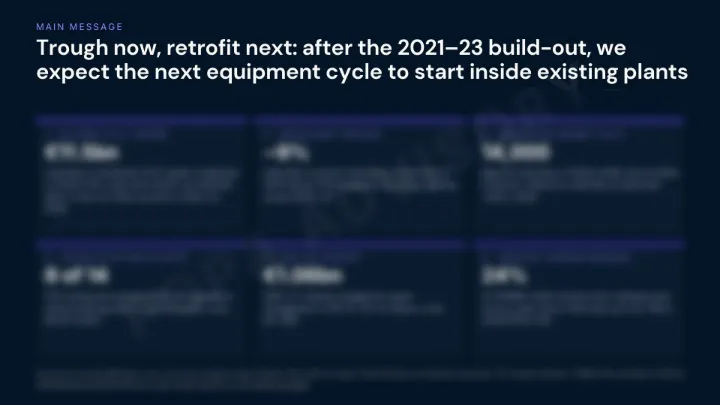
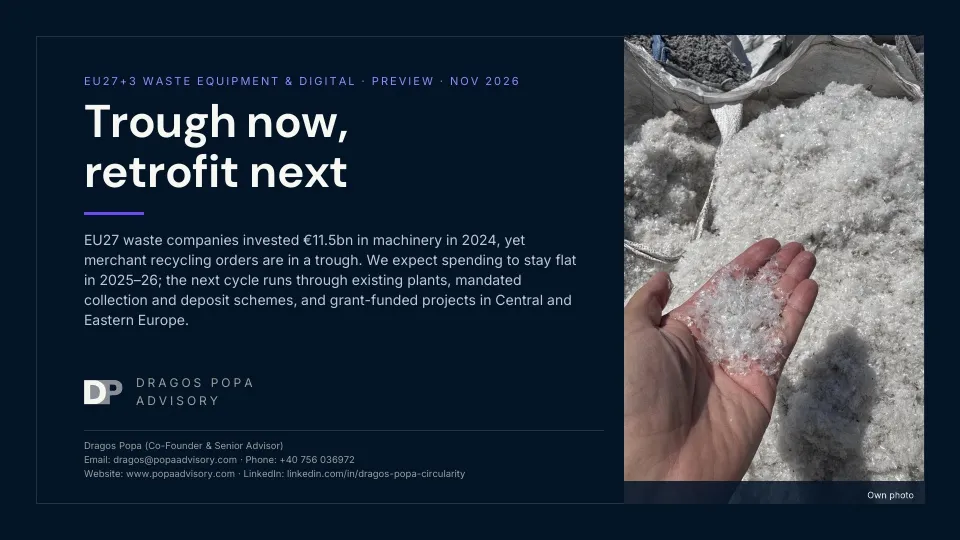
Ahead of Ecomondo in Rimini this week, we put together a preview of our new EU27+3 report on waste equipment and digital solutions: collection, size reduction, sorting, recycling, biological and thermal treatment, and the digital layer across them. Our working message is short: trough now, retrofit next. Here are the three charts behind it.
1. Buyers still spend, but the money has moved
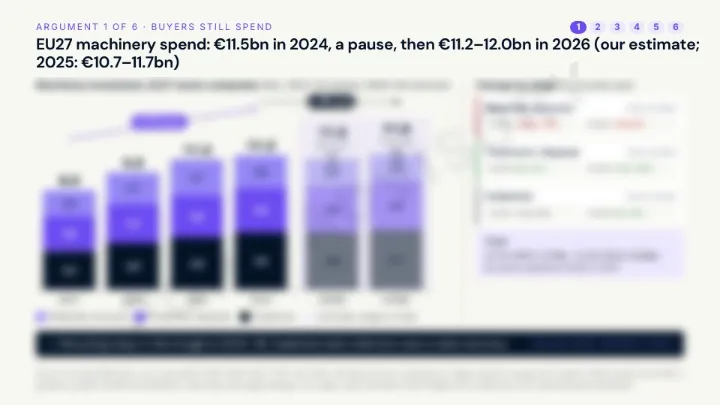
EU27 waste companies invested €11.5bn in machinery and equipment in 2024, up 11% a year since 2021. That is about 5% of the sector's €235bn turnover. The total held up in 2024, but the mix changed: investment in collection rose 10% and in treatment and disposal 5%, while materials recovery, the sorting and recycling plants, cut its machinery spend by 9%.
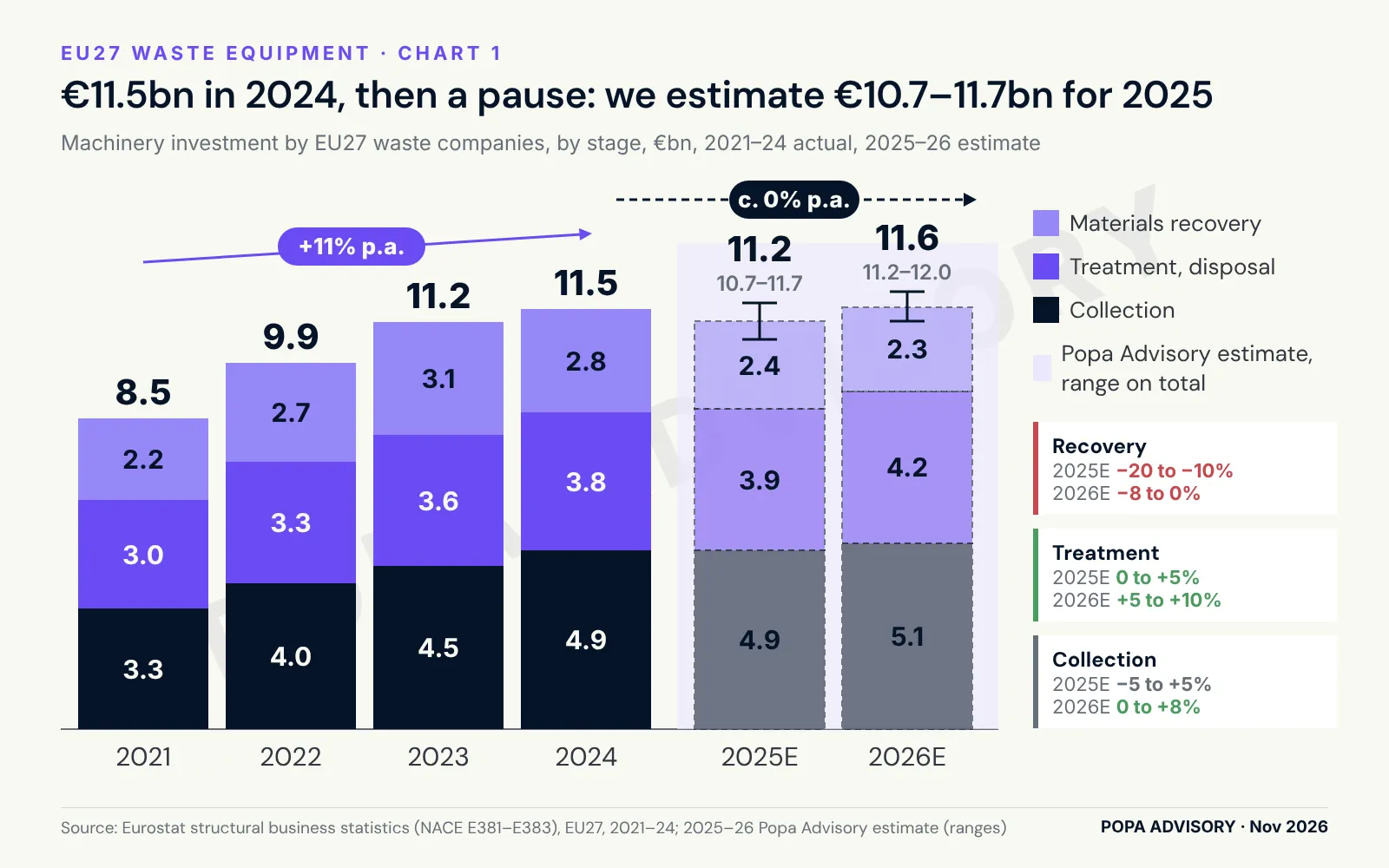
Chart 1: Machinery investment by EU27 waste companies, by stage, €bn, 2021–24 actual and 2025–26 Popa Advisory estimate. Source: Eurostat structural business statistics; Popa Advisory.
Eurostat publishes 2025 only in 2027, so we built our own estimate, stage by stage, from what has happened since: the equipment makers' 2025 results and 2026 guidance, public tenders and EU rules with fixed dates. We estimate €10.7–11.7bn for 2025 and €11.2–12.0bn for 2026: a pause, not a collapse. Materials recovery falls again in 2025 (−20% to −10%), while treatment (+5% to +10% in 2026) and collection carry a slow recovery.
Four markets, Germany, Italy, France and Spain, buy 63% of the machinery. Romania, Poland, Hungary and Czechia together buy about 10% (€1.2bn).
2. 2025 brought no turn for recycling equipment
The companies that sell mainly to merchant recyclers kept losing revenue in 2025: a plastics washing-line maker −78%, a recycling-extruder maker −28%, the recycling unit of the largest optical-sorter maker −18%, a shredder maker −6%. For 2026 that unit still guides −1% to −8%. Behind this sits a hard fact: about 1 Mt of plastics recycling capacity closed across Europe in 2023–25. Recyclers losing money do not buy lines.
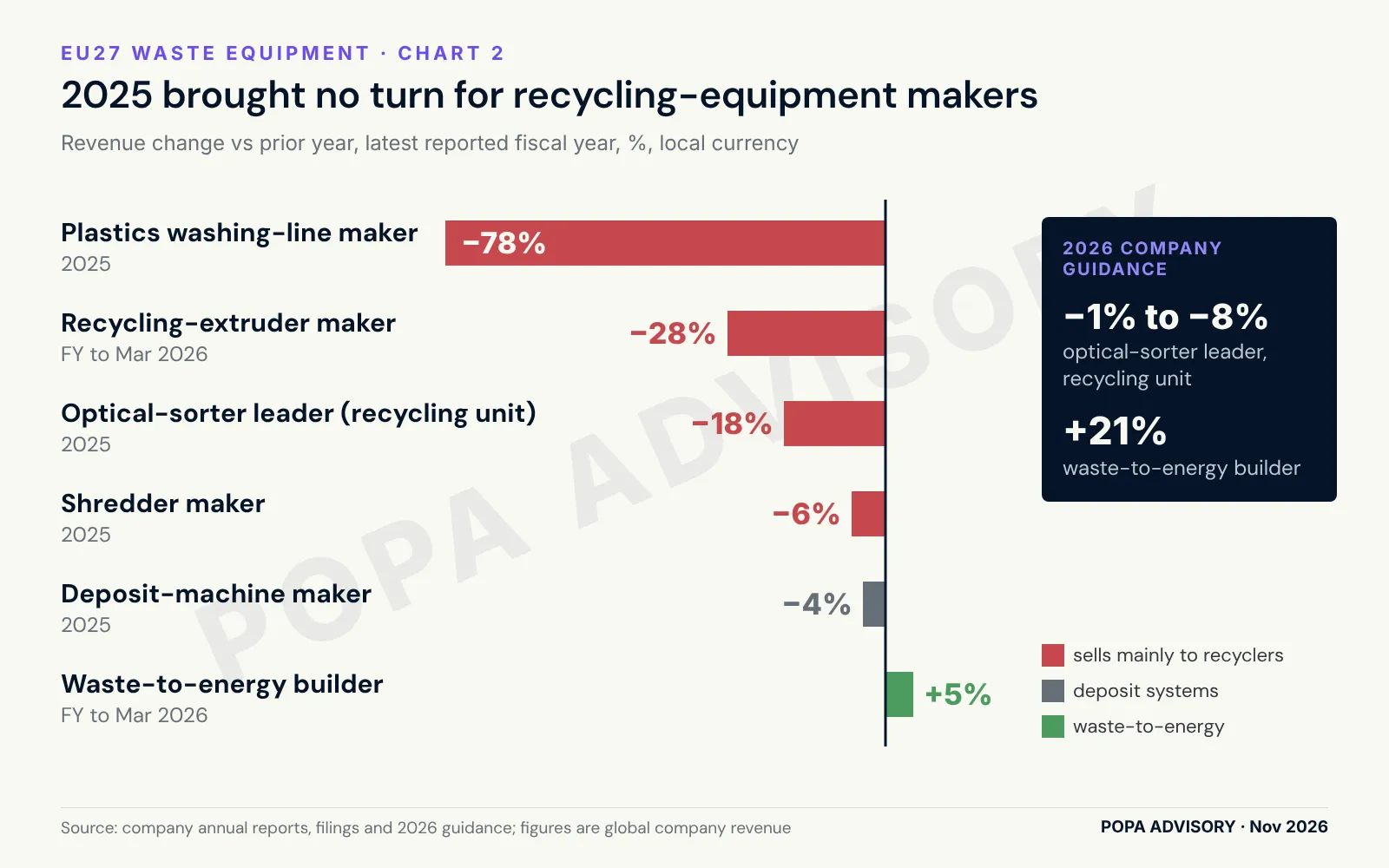
Chart 2: Revenue change at selected equipment makers, latest reported fiscal year, %. Source: company reports and 2026 guidance.
The picture is different where the money is mandated. Deposit-machine makers' revenue fell 4–21% in 2025 as installs shifted to new systems launching in 2026, while waste-to-energy grew 5% in the fiscal year to March 2026, with +21% guided for the next year. Rules with a date create orders that do not depend on recyclate prices: deposit systems must collect 90% of plastic bottles and cans by 2029, PET bottles need 30% recycled content by 2030, and landfill must fall to at most 10% by 2035. Six deposit systems have launched since late 2023, with the UK following in 2027; Poland alone installed 14,000 machines within nine months of launch.
3. The next cycle starts inside existing plants
When orders come back, we expect most of the money to go into plants that already have a hall, a permit and a feedstock. In our sample of public awards, 8 of 14 sorting-line awards in Central and Eastern Europe in 2024–26 upgrade or extend an existing plant. Western operators do the same, from adding one optical sorter to rebuilding a full sorting line.
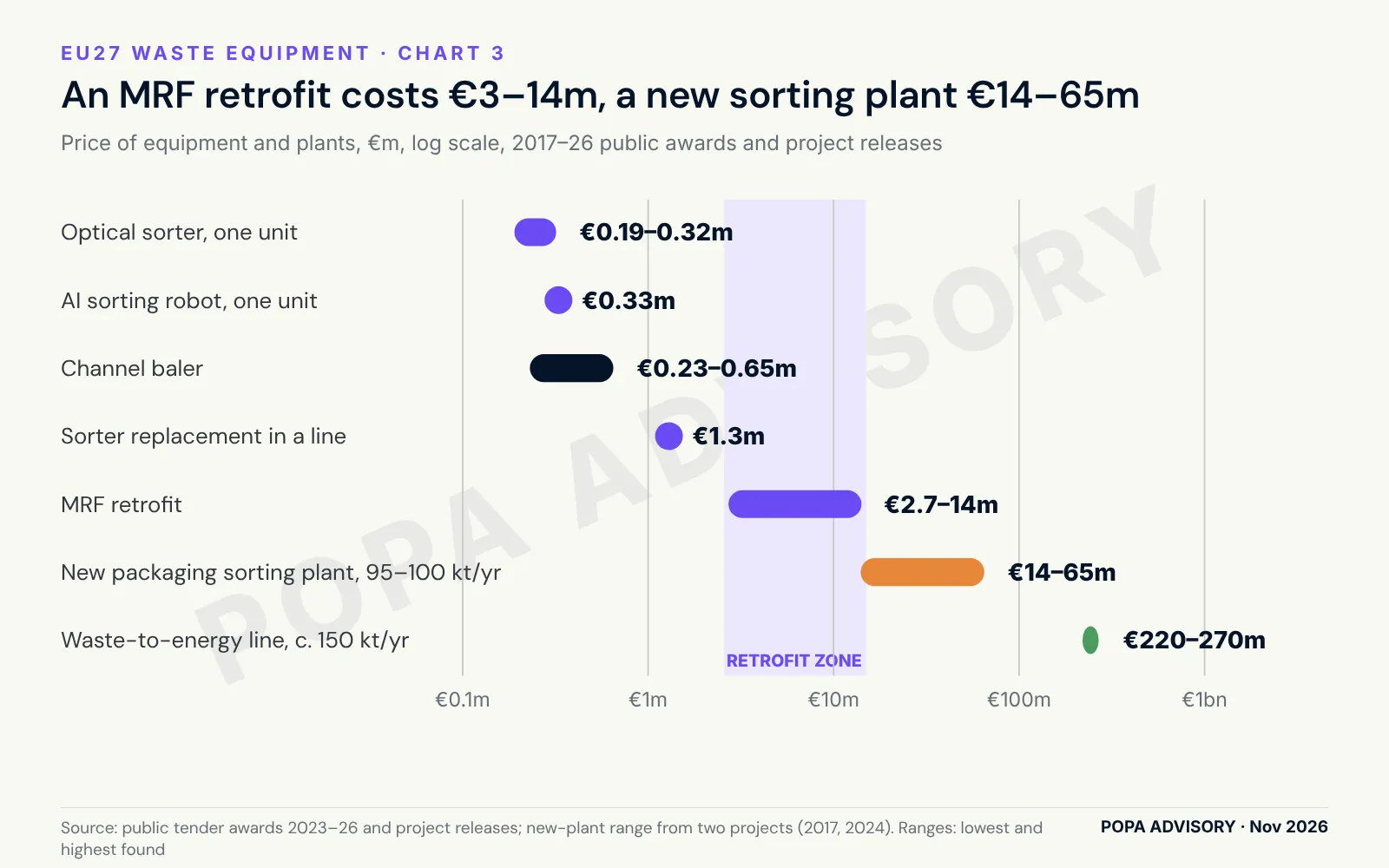
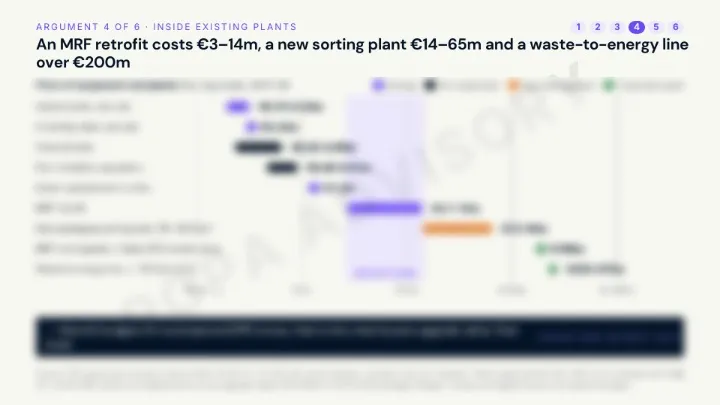
Chart 3: Price of equipment and plants, €m, log scale. Source: public tender awards 2023–26 and project releases.
The economics explain why. An MRF retrofit costs €3–14m, a new packaging sorting plant €14–65m and a waste-to-energy line over €200m. Retrofit budgets fit municipal and producer-responsibility money; new builds need grants or project finance.
Looking to 2030
For 2030 we read two views together. The first is the project pipeline: 91 plants in the pipeline of our asset register and current tenders, priced with the cost ladder above. The second is the capacity the rules require for 2029–30: 90% deposit collection, 30% recycled PET, 55% plastic packaging recycling and 60% municipal recycling. The pipeline gives the floor, the required capacity the ceiling; the full report brings both together.
What it means
- For investors: the installed base is the asset. Service already brings a quarter to three fifths of revenue at the listed waste-equipment makers we checked, and it held flat while equipment sales fell.
- For equipment makers: sell upgrades, not plants. In CEE, where labour costs €11–18 an hour against €42–48 in the West, the pitch is throughput and purity, backed by €1.06bn of 2021–27 cohesion money for waste management in Romania, Poland, Hungary and Czechia.
- For both: safety and compliance are opening the door for digital. Fires in German waste plants rose from 729 in 2021 to 2,028 in 2025, mostly from lithium-ion batteries; the UK regulator began accepting AI-based waste-composition data in 2026.
Meet us at Ecomondo. We are in Rimini on Thursday 5 November to test these assumptions with equipment makers and operators. The full report goes deeper on market size by stage and country, suppliers, technology economics, digital and deals. We bring it to your team as a three-hour strategy context workshop. Contact: dragos@popaadvisory.com · +40 756 036972 · linkedin.com/in/dragos-popa-circularity
Sources: Eurostat structural business statistics (NACE E38, EU27); 2025–26 figures are Popa Advisory estimates (ranges); Eurostat municipal waste and labour cost statistics; EU regulations (PPWR, Landfill Directive, Waste Framework Directive); national deposit system operators; public tender awards (TED) and project releases; company annual reports, filings and guidance; Plastics Recyclers Europe; German waste-plant fire study 2026. Figures are rounded; equipment-maker revenues are global.